🎥 Reshaping Work in the Age of AI — Video Narration by Ansgar Ruhnau
The world of work stands on the precipice of a monumental shift. As artificial intelligence transitions from conversational assistants to autonomous, task-executing agents, business leaders face a defining question: How will we shape the future of enterprise productivity?
To answer this, we must look backward. The structural challenges we face today in deploying AI workflows are not entirely new; they echo the transformation of human work during the Industrial Revolution. By examining the evolution of production plants from isolated steam engines to fully automated assembly lines, we can chart a clear path to building the modern Autonomous Enterprise for digital and knowledge workers.
1. The Four Stages of Transformation: A Historical Parallel
To unlock the true value of AI, organizations must move beyond using technology purely for personal productivity. Like the mechanical innovations of the 19th and 20th centuries, digital automation progresses through four distinct stages:
Stage 1: Job-Based Production vs. Individual Prompting (Personal Productivity)
The Industrial History: In the late 18th century, early steam engines and water wheels were introduced into cottage workshops. A single weaver or blacksmith might use a steam-driven hammer to speed up their physical work. While this amplified their individual output, the artisan still manually managed every other aspect of the job in isolation. The “cottage industry” remained fragmented.
The AI Era: This is the current state for most organizations today. Employees adopt AI assistants (like ChatGPT or Copilot) to execute isolated tasks—summarizing a meeting, writing a draft email, or writing a code snippet. Individual productivity rises, but the overall business process remains fragmented and manually bound.
🎯 Maturity Milestones: Ad-hoc usage with no centralized strategy; Basic prompt engineering literacy; Outputs do not automatically trigger other workflows.
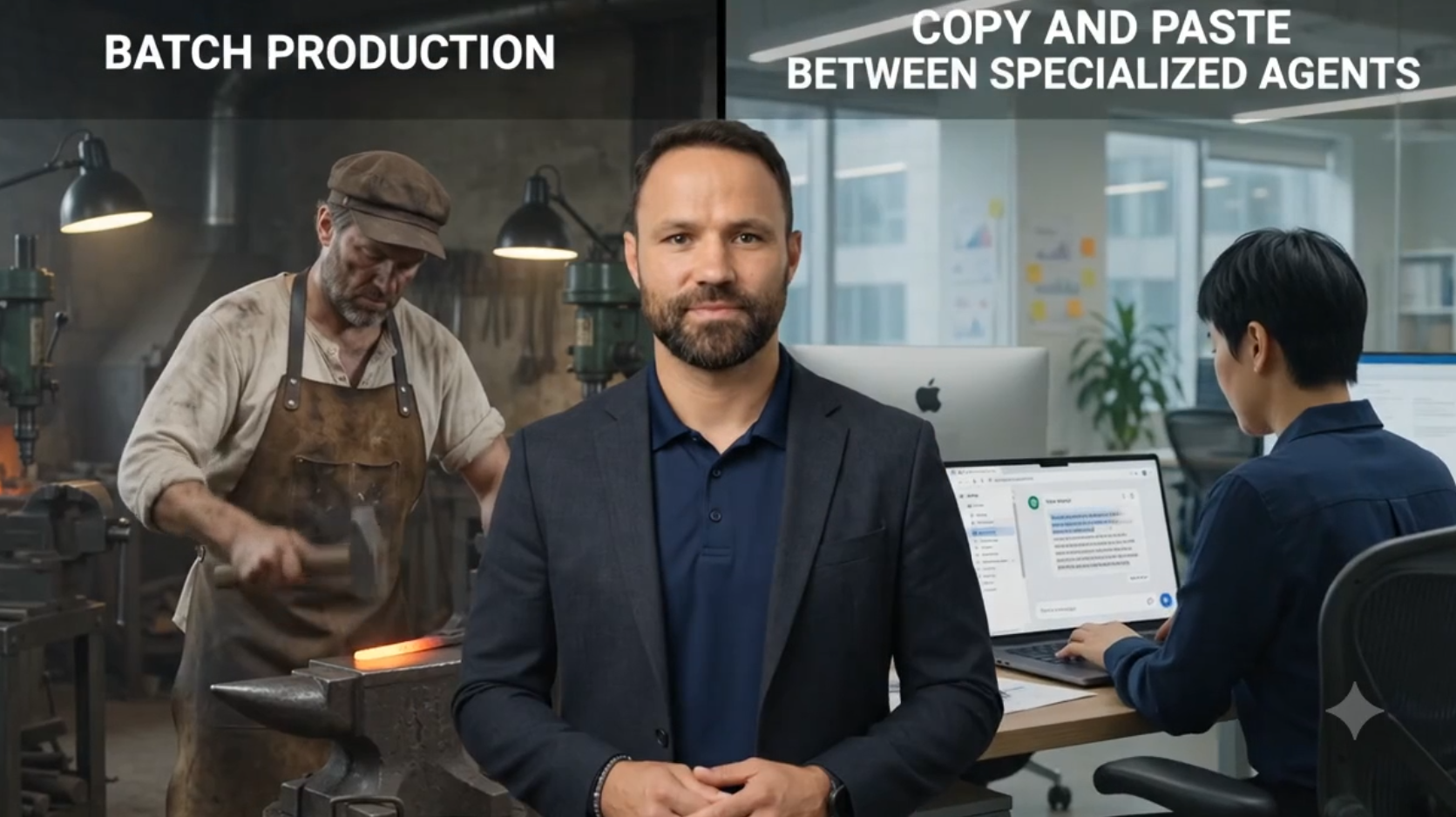
Stage 2: Batch Production vs. The Copy-Paste Gap (Disconnected Agents)
The Industrial History: Factories began grouping specialized machinery into separate rooms or workshops. A worker used a steam-driven carding machine to prepare wool, manually bundled the output, and physically carried it to another station for spinning. These manual hand-offs between specialized, disconnected machines created massive operational friction and inventory bottlenecks.
The AI Era: Companies deploy multiple specialized AI tools across different departments (e.g., an invoice parser, a translation bot, an email generator). However, these systems do not talk to each other. The human worker becomes the “connective tissue,” manually copying text from the output of one agent and pasting it into the input of another.
🎯 Maturity Milestones: Departmental silos utilizing specialized AI agents; Significant human hours spent copy-pasting data between systems; Lack of shared memory or database integrations.
Stage 3: The Automated Assembly Line vs. Connected Hand-offs (Connected Agents with Human Review)
The Industrial History: Henry Ford revolutionized production by introducing the moving assembly line. Instead of workers carrying parts between stations, a mechanical conveyor belt moved the chassis automatically. However, human workers still stood at every station to mount parts, check quality, and manually verify the work before it proceeded.
The AI Era: Organizations use APIs and automation layers (like n8n, Make, or custom scripts) to connect specialized agents and enterprise databases (CRM, ERP, Email). Data flows automatically between systems. However, human intervention is still required at critical gates—not to move the data, but to review, correct, and click “approve” before the workflow can proceed.
🎯 Maturity Milestones: Automated API-based data transfer between agents; “Human-in-the-loop” gating for quality assurance and compliance; Process logs are actively monitored to find operational bottlenecks.
Stage 4: Autonomous Production vs. The Autonomous Enterprise (End-to-End Orchestrated Autonomy)
The Industrial History: The modern automated production plant. Robotic arms, smart conveyors, and real-time sensors build complex machinery without manual human touch. Humans are no longer part of the repetitive loop; they have transitioned to the control room, monitoring performance dashboards, optimizing system parameters, and resolving rare anomalies.
The AI Era: The Autonomous Enterprise. Entire workflows—from a customer query arriving in an inbox, through translation, CRM updates, backend drafting, and shipping notifications—are mapped and executed automatically by a network of systems and AI agents. The workflow runs end-to-end in the background, only prompting human professionals when a complex exception occurs. Humans focus on governance, strategic direction, and building relationships.
🎯 Maturity Milestones: Fully digital, end-to-end automated workflows; “Approval-by-exception” replacing routine checks; Self-healing systems that automatically handle minor data validation errors.
2. AI Revolution vs. Industrial Revolution: What is Same and What is Different?
As we navigate this transition, we must recognize the deep historical parallels and the critical differences that define our current era:
| Dimension | What is the Same? (Parallels) | What is Different? (Divergences) |
|---|---|---|
| Systemic Integration | The real value of steam power was only unlocked by reorganizing factory layouts. AI’s true return on investment lies in connected workflows, not individual prompt tricks. | Speed of Disruption: The Industrial Revolution unfolded over 150 years. The AI era is compressing this transformation into a single generation (decades or years). |
| Human Adaptation | Technology changes exponentially, but human organizations and behaviors adapt logarithmically. Managing this adaptation lag remains the biggest leadership challenge. | Nature of Labor: The Industrial Revolution automated muscle power and physical labor. The AI revolution is automating cognitive power and knowledge work. |
| Labor Concerns | Just as Luddites feared displacement and loss of dignity, modern knowledge workers face deep anxiety regarding job security and their professional identity. | Capital Concentration: Industrial assets required physical facilities. AI assets require centralized data and massive GPU compute power, creating higher inequality risks. |
3. Critical Lessons from History: Mistakes to Avoid
To ensure the transition to the Autonomous Enterprise benefits both organizations and their people, business leaders must actively avoid the historic mistakes of the industrial age:
- Avoid Technological Determinism: History shows that technology does not automatically generate prosperity for everyone. The early decades of industrialization (the “Engels’ Pause”) saw massive wealth creation alongside stagnant wages and harsh child labor. Growth only became equitable through active governance, labor reforms, and public education. AI governance and workforce upskilling must be prioritized from day one.
- Do Not Turn Workers into Cogs (Taylorism): Early industrial management treated workers as mindless links in a mechanical chain. In the AI era, using intelligent automation to micromanage employees or reduce them to simple data copy-pastes and checklist clickers will destroy engagement. AI must be used to augment human intelligence, freeing professionals to focus on relationship-building, empathy, and strategic thinking.
- Clean the Process Before Automating: Dumping a high-speed steam engine into an unorganized, chaotic workshop simply created broken products faster. Similarly, layering AI onto broken, undocumented, or dirty processes will only result in automated chaos. Focus on process discovery and data integrity before automation.
- Foster Psychological Safety: Industrial workers resisted change because they saw the machine as a threat to their survival. Leaders must build environments of trust where employees feel secure to experiment with AI and actively participate in reshaping their roles, rather than fearing replacement.
Conclusion: Steering Toward a Human-Centric Future
Reshaping work in the age of artificial intelligence requires us to look beyond the personal productivity gains of individual chat prompting. The true destination is the Autonomous Enterprise—a system where specialized agents and core applications operate in harmonized workflows, governed and steered by human leaders.
By learning from the successes and failures of the Industrial Revolution, we can build a future of work that does not diminish the human worker, but elevates them to new heights of creative and strategic potential.
 The Opportunity for Human Reso…